

A DWI arrest is not a conviction. In New Jersey, DWI cases fall under N.J.S.A. 39:4-50, and a conviction may bring license loss, fines, or imprisonment. A New Jersey DUI lawyer can examine how the stop, arrest, and test evidence were handled before the case moves forward.
It’s understandable to focus on the test result or the possibility of losing your license. But a test result does not answer every question about the evidence, and an arrest does not establish that the state can prove its case.
This guide explains what may happen after a New Jersey DWI arrest, what penalties can depend on, and how a defense attorney can challenge a traffic stop, an arrest, or chemical-test results. You’ll also learn what legal representation can involve and what steps to take next.
Key Takeaways
- See how potential consequences can change with the offense history and test results.
- Learn which parts of a traffic stop and breath-test evidence may be challenged.
- Understand how ignition interlock requirements may affect a first-time DWI case.
- Find out how legal representation can examine the evidence and address the charges.
How Can A New Jersey DWI Attorney Help?
An attorney can assess the evidence and explain how New Jersey’s DWI penalties may apply. The charge is governed by N.J.S.A. 39:4-50.
Offense-Based DWI Penalties
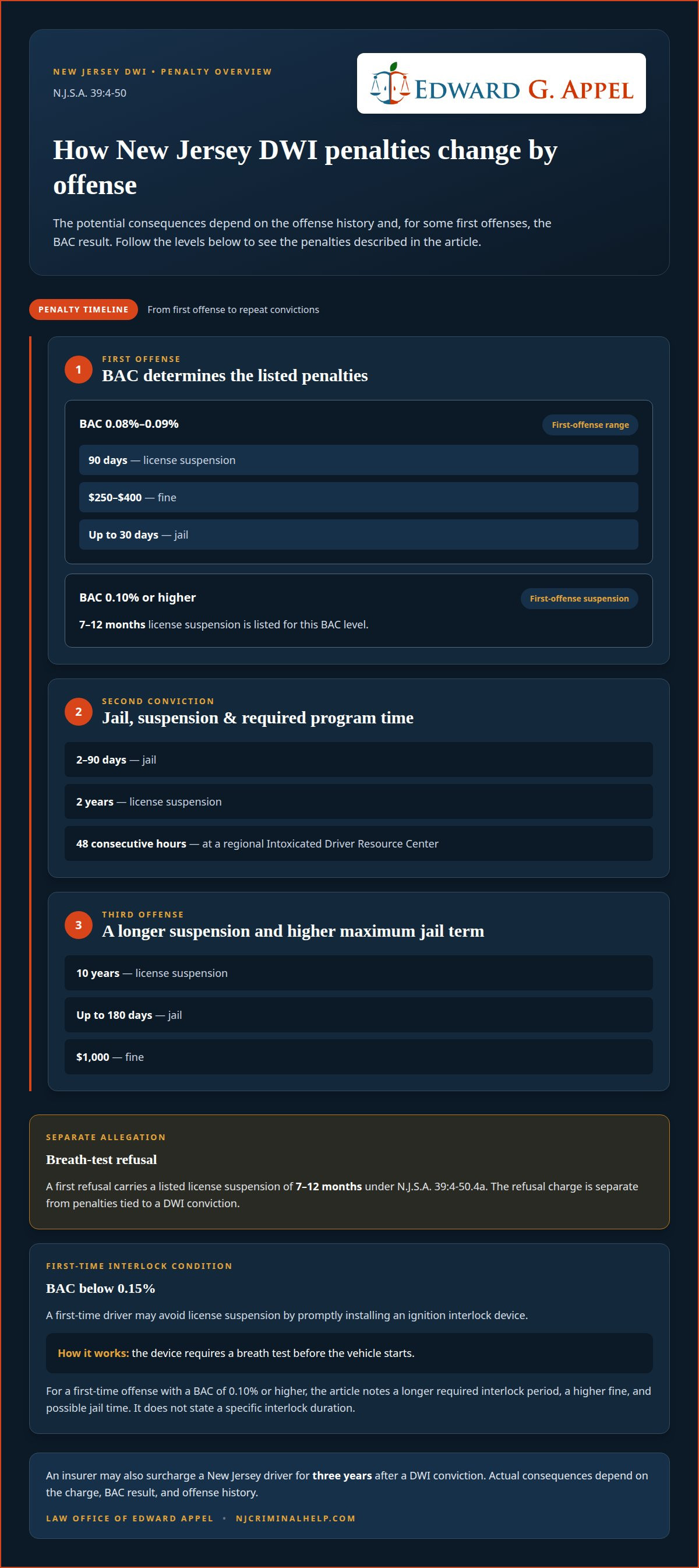
For a first offense with a BAC of 0.08 to 0.09 percent, penalties include a 90-day license suspension, a $250 to $400 fine, and up to 30 days in jail. At a BAC of 0.10 percent or more, the listed suspension is 7 to 12 months. The offense level and test result shape the exposure.
A second conviction can bring 2 to 90 days in jail, a two-year license suspension, and 48 consecutive hours at a regional Intoxicated Driver Resource Center. A third offense carries a 10-year suspension, up to 180 days in jail, and a $1,000 fine. A DWI attorney can assess which penalties apply to the charge.
Repeat Conviction Consequences
Repeat DWI convictions raise the stakes beyond a single court appearance. A second offense can mean jail, a two-year suspension, and required detainment; a third can mean 180 days in jail and a 10-year suspension. An insurer may also surcharge a New Jersey driver for three years after a DWI conviction.
Reviewing prior convictions and the current evidence helps clarify potential consequences. A New Jersey DUI lawyer should examine the stop, officer observations, test records, and how the state is treating any alleged prior offenses.
Breath-Test Refusal Penalties
Refusing a breath test can lead to a separate charge under N.J.S.A. 39:4-50.4a. A first refusal carries a listed license suspension of 7 to 12 months. That consequence is distinct from penalties tied to a DWI conviction, so the refusal allegation needs its own review.
An attorney can examine the circumstances surrounding the officer’s request and the refusal allegation. The key is to assess the evidence and the separate refusal charge, rather than assume that refusing a test replaces or resolves the DWI case.
To choose a New Jersey DUI lawyer, look for focused DWI defense and a clear plan to scrutinize the stop, arrest, and test evidence. Ask how the attorney will assess the specific charge and any prior convictions.
How long a DUI stays on your record in New Jersey depends on which record you mean, such as your driving history or criminal record. A conviction can also affect how repeat-offense penalties are assessed.
Reviewing the case helps connect the alleged conduct to the applicable penalties, including alcohol-related charges and any refusal allegation.
Challenging traffic stops and breath-test results
A breath-test result is evidence, not the whole case. Review the stop, the officer’s observations, and the testing records as separate parts of the defense.
Traffic Stop Challenges
Reviewing the stop starts with the officer’s stated reason and the events just before it. A defense attorney compares that explanation with available video, reports, and witness accounts. If the stated basis changes or recorded conduct differs, those gaps may matter. The circumstances are important: a later breath-test result does not establish whether the stop was properly supported.
Alcotest Reliability and Calibration
New Jersey uses the Draeger Alcotest 7110 breath-testing machine. In State vs. Chun, 194 N.J. 54 (2008), the New Jersey Supreme Court ordered the state to fix 9 software issues during the Alcotest reliability litigation. That history makes the machine’s records relevant, not conclusive. A defense review examines the test documentation and calibration information tied to the specific reading.
Breath-Test Evidence
An Alcotest reading of 0.08% or greater doesn’t by itself establish that the result was accurate. The defense attorney can examine how the test was administered and whether the recorded results and supporting documents align. Prosecutors may rely on a number, but the practice of testing and the evidence behind it also matter. A discrepancy can change how much weight the result deserves.
Breath, Blood, and Urine Testing
Breath, blood, and urine results are different forms of evidence, so each requires a review suited to its record. The defense can compare the reported result with the test documentation and the officer’s observations. A reported blood-test reading of 0.320, for example, did not prevent a New Jersey DWI charge from being dismissed. The number alone doesn’t resolve the evidence.
A focused DWI defense review can examine the stop and testing records together.
Is DWI A Criminal Charge In New Jersey?
New Jersey prosecutes DWI under N.J.S.A. 39:4-50. A conviction can affect driving privileges, and ignition interlock requirements may shape the outcome.
For a first-time DWI with a BAC below 0.15%, a driver may avoid license suspension by promptly installing an ignition interlock device. The device requires a breath test before the vehicle starts. That option makes timing and the recorded BAC important parts of the case. A suspension and an interlock requirement are separate consequences, so review both.
For a first-time offense with a BAC of 0.10% or higher, New Jersey requires a longer ignition interlock period, and the case carries a higher fine and possible jail time. The specific BAC result matters. A person found guilty should understand how the result affects driving privileges and sentencing, not assume an interlock eliminates every consequence.
Sentencing and license consequences depend on the charge and evidence. A DWI case may involve questions about the breath test and eligibility for an ignition interlock. The device does not erase a conviction. Under the stated BAC condition, it may affect whether a first-time driver avoids suspension.
State vs. Chun, 194 N.J. 54 (2008), is New Jersey’s Alcotest reliability case. The New Jersey Supreme Court ordered the state to fix 9 software issues during that litigation. A technical review can examine the machine’s records and testing conditions. Radio-frequency interference may also be considered as a possible source of testing disruption, but it should not be confused with the software issues addressed in Chun.
There is no single deadline for every challenge to a DWI charge or license suspension. Timing depends on the notice, the procedural issue, and the court process. Review the summons and suspension paperwork promptly so your defense can identify the relevant deadline and prepare a response.
In a drunk-driving case, the charge, BAC evidence, and interlock conditions must be considered together. A breath-test result alone does not explain every consequence of driving while intoxicated.
Challenging traffic stops, arrests, and testing
A DWI defense examines the full chain of evidence, from the officer’s first contact to the Alcotest result. A weakness at one stage can affect how prosecutors present the charges in municipal court.
Start with the stop. The defense reviews the officer’s stated reason, the sequence of events, and any available recordings or witness accounts, then compares them with the police report. If the account changes or a recording conflicts with the report, that inconsistency may matter. The question is whether the evidence supports the stop, not simply whether the officer later suspected intoxication.
Next, examine the arrest decision. New Jersey DWI convictions may be based on an officer’s observations and field sobriety tests, even without a chemical-test result. Those observations deserve close scrutiny. A defense attorney can compare the report with video, descriptions of the tests, and the driver’s conduct. The circumstances surrounding each claimed sign of impairment can affect how much weight it carries.
Then review the Alcotest evidence. A reading of 0.08% or greater does not alone establish accuracy. State vs. Chun, 194 N.J. 54 (2008), addressed Alcotest reliability, and the New Jersey Supreme Court ordered fixes for 9 software issues. Case review can examine instrument records, calibration documentation, and test procedures. Those details help determine whether the result supports the charge.
These are separate challenges, not one general claim that testing was flawed. The county’s municipal court handles the case, but the evidence still needs a step-by-step review. A defense should connect each challenge to a record, observation, or testing detail, giving the court a concrete basis to assess the allegations.
If you face serious DWI charges after a stop or test you dispute, seek a focused review of the evidence and court paperwork.
Law Office of Edward Appel
Law Office of Edward Appel represents people facing New Jersey DWI charges and related court proceedings. Its DUI / DWI Defense and Criminal Defense address the allegations, evidence, and potential consequences in each case.
Turn to an attorney after an arrest, when you receive a summons, or when questions arise about a traffic stop, officer observations, or test results. A case review can focus on what the records show, how the charges are supported, and which issues require a response in court. Traffic Violations defense may also be relevant when the arrest involves related driving allegations.
If you’re facing a DWI charge in New Jersey, contact Law Office of Edward Appel to discuss your case and next steps.
Take the Next Step With a Clear Plan
The next step is to organize a focused case review. Keep your summons, suspension notice, and arrest paperwork together. While the details are fresh, write down what you remember about the stop, the officer’s instructions, and the testing process. These records can help clarify which issues deserve attention and what questions remain.
A New Jersey DUI lawyer can assess how the evidence and charges fit together, then explain the steps available in your case. Law Office of Edward Appel handles DUI / DWI Defense, Criminal Defense, and Traffic Violations, connecting related driving allegations with the broader defense strategy when appropriate. Since every case is different, the review should focus on your circumstances rather than assumptions about the outcome.
If you’re ready to discuss the charges and your next steps, contact Law Office of Edward Appel. A direct conversation can help you approach the process with a clearer plan and steadier footing.
Frequently Asked Questions
What Happens After A DWI Arrest?
After a New Jersey DWI arrest, the allegations and supporting evidence become central to the case. Keep the summons, police paperwork, and notices together. While your recollection is fresh, write down what happened during the stop and arrest, including what the officer said and what tests occurred. A New Jersey DUI lawyer can use those details to identify questions for the defense and explain the next court steps.
Can You Face DWI Charges If Your Bac Was Below The Legal Limit?
Yes. A driver can face a New Jersey DWI ticket below 0.08% BAC if the state alleges alcohol impaired driving. The legal question isn’t limited to the breath-test number. The officer’s observations and other evidence may also matter. For example, the state may rely on reported driving behavior or field sobriety test performance. The result and the surrounding circumstances should be assessed together.
Can You Really Win Against A DWI Charge?
Yes, a DWI charge can be contested, but the evidence and legal issues determine the defense. A case review can compare the officer’s report with available recordings, scrutinize test records, and assess whether the evidence supports the allegations. A dismissal or acquittal depends on what the court accepts and whether the state proves the charge. A breath-test result alone does not answer every question.
What Happens When You Get A DWI In New Jersey?
A New Jersey DWI allegation proceeds through the court process, where the charge and evidence are addressed. A conviction may affect driving privileges and bring fines or imprisonment. Consequences depend on factors such as prior offenses and the evidence in the case. Keep all court and license notices together, since they may relate to separate parts of the case and require prompt attention.
What Qualifies As A DUI In New Jersey?
New Jersey’s DWI law covers driving while impaired by alcohol, as well as driving with a BAC of 0.08% or greater. The statute is N.J.S.A. 39:4-50. A driver below that BAC can still face a ticket if the state alleges impairment. For commercial drivers, the listed BAC threshold is 0.04%. The charge turns on the circumstances and evidence, not just the label used.
What Are New Jersey DUI Penalties For A First Offense?
Penalties depend in part on BAC. A first offense may result in a license suspension, a fine, or jail time, depending on the circumstances. At 0.10 percent or more, the license suspension is 7 to 12 months, with a $1,000 annual surcharge for three years. An ignition interlock requirement may also apply.